
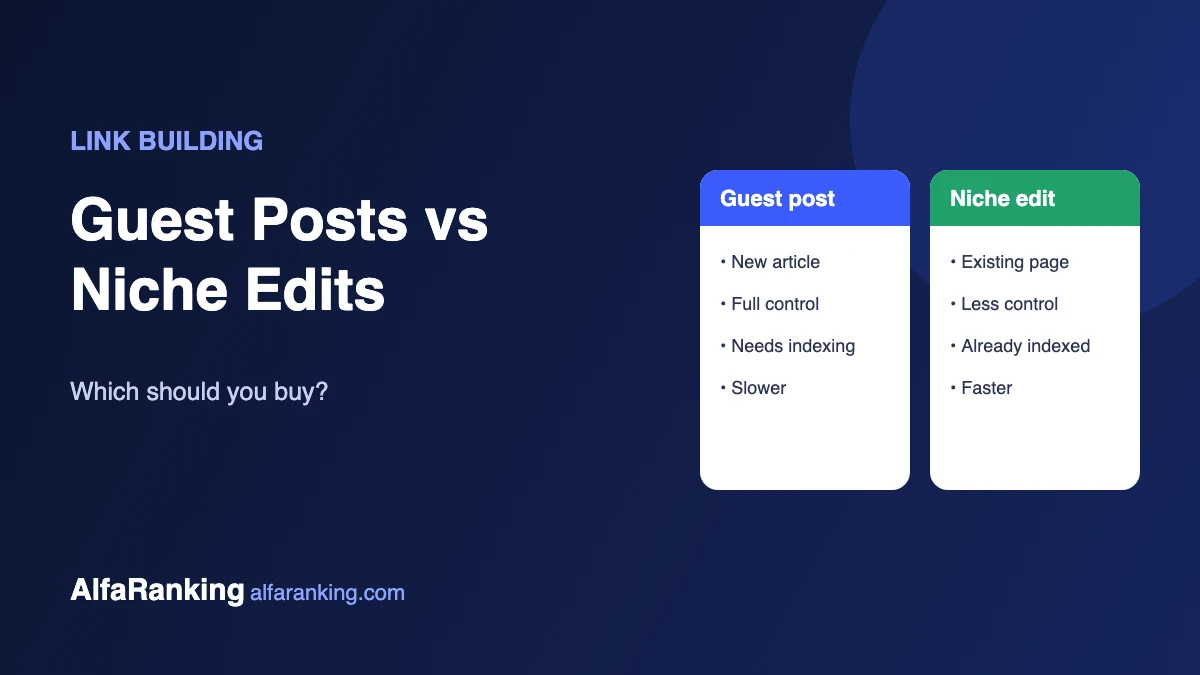
If you buy links, you’ll be offered two main options: a guest post, where a new article is published with your link in it, or a niche edit, where your link is added to an article that’s already live. Sellers often present niche edits as the faster, cheaper choice. Sometimes they are. Sometimes they come with risks that aren’t mentioned in the offer.
Here’s how the two compare, and how to decide which one fits your situation.
What each one is
A guest post is a new article written for the publisher’s site, usually by you or your provider, that includes a link to your page. You decide the topic, the angle and where the link sits.
A niche edit (also called a link insertion or curated link) is a link added to an existing article on someone else’s site. The page may be months or years old and may already rank and get traffic.
Side by side
| Guest post | Niche edit | |
|---|---|---|
| Content | New article you control | Existing article written by someone else |
| Indexing | New page needs to be crawled and indexed | Page is usually indexed already |
| Context | Written around your topic | Link has to fit an article that wasn’t written for it |
| Speed | Slower: writing, review, publishing | Faster: a small edit |
| Traffic to the page | Starts at zero | May already have visitors |
| Main risk | A weak site or thin article | Edited pages that are sold over and over, or links that disappear in an update |
The case for niche edits
An older page that already ranks and gets traffic can pass more value than a brand-new article, and the link can be live within days. When the existing article is genuinely about your topic and your link adds something useful for readers, a niche edit can be a good placement.
Where niche edits go wrong
- The same pages are sold again and again. Some articles collect dozens of inserted links over time, each to a different business. That page looks like a link list, not an article.
- The link doesn’t fit. Squeezing a SaaS link into a five-year-old travel post looks unnatural to readers and to Google.
- Links vanish. When the owner updates or rewrites the article, inserted links are often removed.
- Hacked or reused sites. Some offers come from sellers with access to sites they don’t own. If the owner finds and removes the link, you’ve paid for nothing.
The case for guest posts
A guest post gives you control. The whole article supports your topic, so the link sits in a relevant context and you choose the anchor text and the target page. You also get a piece of content that can bring referral visits if the site has real readers. The trade-off is time and cost, and a new page has to earn its own place in Google’s index.
Where guest posts go wrong
The main risk is the site, not the format. A guest post on a site full of other sponsored articles, with little real traffic, is worth very little. Check the publisher before you buy, using the same 12 checks we run, and watch for the signs of a link farm.
The rules are the same for both
Google’s spam policies don’t treat niche edits differently from guest posts. Buying a link that passes ranking credit is a link scheme either way. Paid placements should be marked rel=”sponsored” or nofollow, and a seller who promises “undetectable” links is describing the problem, not a feature.
How to check a niche edit offer
- Open the exact page, not just the domain, and check that Google has indexed it.
- Look at that URL’s own organic traffic and keywords in an SEO tool.
- Count the outbound links in the article. Lots of links to unrelated businesses is a warning sign.
- Read the paragraph where your link would go. Would a reader find it useful there?
- Ask whether the site owner made the edit, and what happens if the link is removed.
Which should you choose?
| If you… | Lean towards |
|---|---|
| Need full control over context and anchor text | Guest post |
| Found a relevant, indexed page with real traffic and few outbound links | Niche edit |
| Are building links to a new service or feature page | Guest post |
| Can’t verify who controls the site | Neither |
| Are being offered a page with dozens of inserted links | Neither |
For most businesses, a mix works best, but quality matters more than format. One placement on a relevant site with real traffic is worth more than several on pages nobody reads. If you’re unsure what to look at, start with what DR does and doesn’t tell you.
Want guest posts on sites that pass these checks?
We place guest posts on hand-vetted sites with real organic traffic and tell you how each publisher marks paid links before you pay. Browse sample sites by niche or tell us your niche and get a free list.