
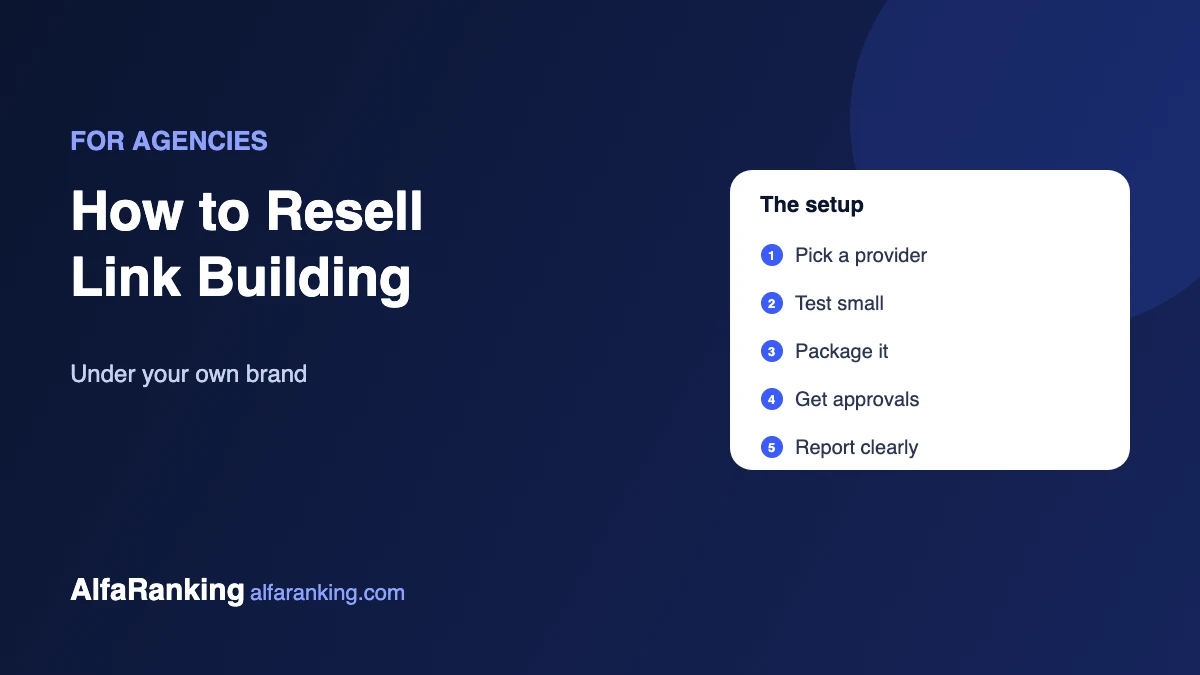
Reselling link building is one of the simplest services an agency can add. Your clients already need links, you already manage their SEO, and a good partner handles the outreach and publishing. Done well, it’s steady recurring work. Done badly, it puts your agency’s name on links you can’t defend.
Here’s how to set it up so clients get real value and you stay in control.
What reselling actually means
You sell link building to your clients under your own brand. A partner, usually called a white-label provider, finds the sites, writes or places the content and publishes it. You handle the client relationship: strategy, target pages, approvals and reporting. The client deals only with you.
What clients are really buying
Clients don’t want “links” for their own sake. They want important pages to rank higher, and they want to know the money was well spent. That means your offer should be framed around target pages and site quality, not a count of links or a DR number. A client who understands why each placement was chosen is much easier to keep.
Choosing a provider
This is the decision that matters most. Ask any provider:
- How do you vet sites? Ask for the checks, not just “high DA”.
- Can I see the metrics, including organic traffic, before I approve a site?
- How do publishers mark paid links: rel=”sponsored”, nofollow or standard?
- What’s in your report, and is it unbranded?
- What are your payment terms, and which sites need payment upfront?
- What happens if a link is removed after publishing?
Then test them with a small order and check every placement yourself using our 12 site-quality checks.
Packaging it for clients
Most agencies use one of three structures:
| Structure | How it works | Best for |
|---|---|---|
| Per placement | Client approves and pays for each site | Clients who want control |
| Monthly package | A set number of placements each month | Ongoing SEO retainers |
| Campaign | A fixed set of links to one page or launch | New services or product launches |
Whatever you choose, price per site rather than per DR tier, because two sites with the same DR can be worth very different amounts. Build your margin into the price you quote, and be clear about what’s included: content, approvals, reporting.
Getting client approval
Send clients a shortlist before anything is bought: the site’s topic, traffic, DR and the target page. It takes an extra day, but it removes most disputes later and makes clients feel involved rather than billed.
Handling payment terms
Payment terms differ between publishers. Many are paid after the article is live, while some only work with payment upfront. Know which is which before you quote, and pass the terms on to your client clearly. If a site needs upfront payment, collect it from the client before you order, so your agency isn’t carrying the risk. Keep a column for payment terms and payment status in your order tracker.
Setting expectations
Tell clients early that links take time to show an effect, often months, and that no one can guarantee rankings. Agree what you’ll report and when. Clients who expect a slow, steady build are far more patient than clients who were promised quick jumps, and they’re less likely to cancel after the first month.
Reporting under your brand
Your report is the product the client sees. Each placement needs the live URL, target page, anchor text, link attribute, dated metrics and status. We cover the full layout in what a white-label link building report should include.
Red flags that put your agency at risk
- A provider that only talks about DR and avoids traffic questions
- Placements on sites that cover every topic and publish mostly sponsored posts
- “Permanent dofollow” promises or “undetectable” links
- Reports without live URLs
- Pressure to buy in bulk before you’ve tested quality
Each of these can end with a client asking why their links are on link farm sites. It’s your name on the report, not the provider’s.
Start small
Begin with one or two existing clients who already trust you. Run a small campaign, check every link, report honestly, and then offer it more widely once you’re confident in the quality.
Questions to agree with your provider up front
- Who writes the content, and can you or the client approve it before publishing?
- How long do placements usually take from approval to live link?
- How are disputes handled if a publisher changes or removes a link?
- Do they ever contact your clients directly? (The answer should be no.)
Write the answers down. When something goes wrong months later, a short written agreement saves a lot of back-and-forth, and it protects your client relationship as well as your margin.
Looking for a white-label partner?
Our white-label link building service is built for agencies: vetted sites, metrics before you buy, and unbranded reports. Tell us about your clients’ niches and we’ll send matching sites.