

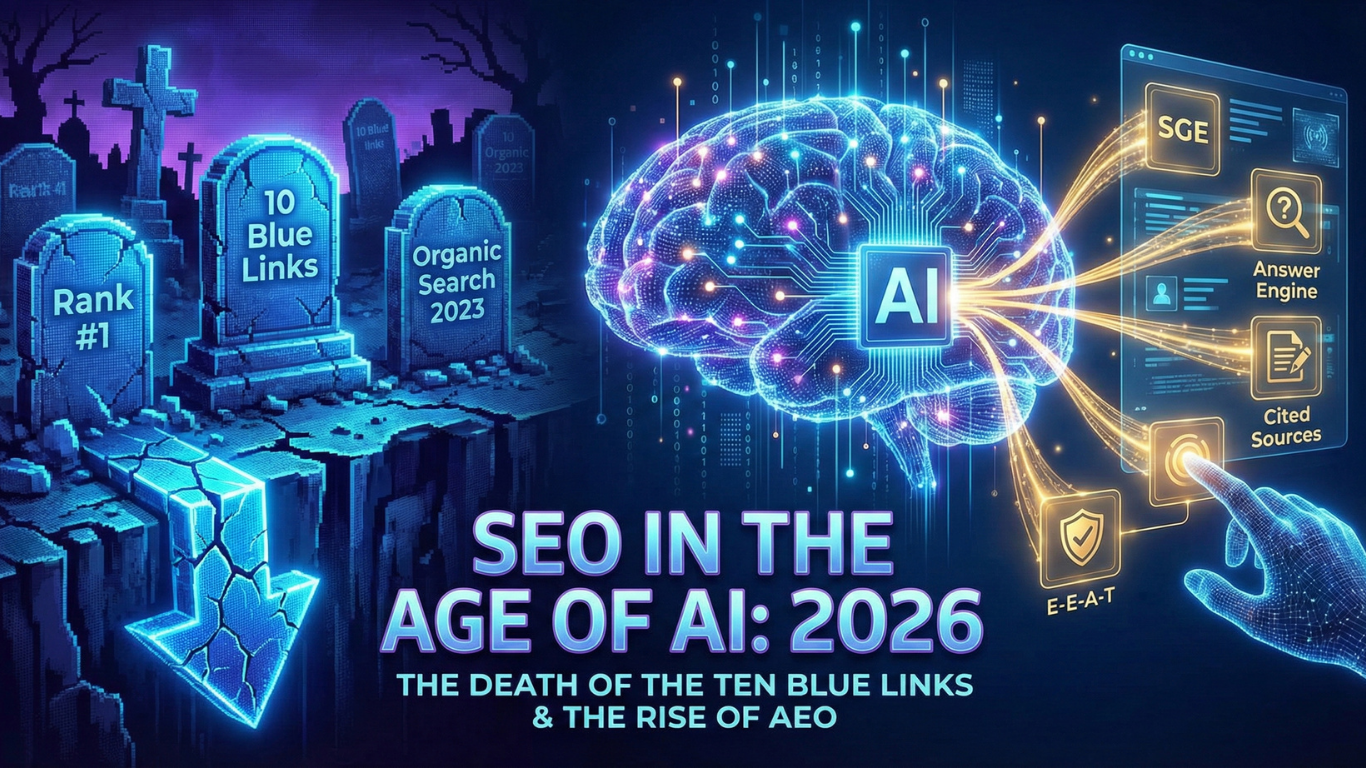
The days of simply optimizing for Ten blue links on Google are over. With the dominance of Search Generative Experiences (SGE) and AI-driven answers, SEO in 2026 requires a fundamental shift in strategy. It is no longer about keywords; it is about being the cited source in an AI’s answer.
If you are reading this in late 2025, you have already seen the shift. The “Great Decoupling” has occurred: search volume is at an all-time high, yet organic click-through rates (CTR) to websites are at an all-time low. The funnel has moved. It is no longer happening on your landing page; it is happening directly on the search results page (SERP).
To survive the transition to 2026, we must stop thinking like search engines and start thinking like Answer Engines.
Table of Contents
How SGE Changes Click-Through Rates
By mid-2025, the data became undeniable. For informational queries—those “how-to,” “what is,” and “who did” searches—organic traffic has plummeted for traditional blue links.
In the old world (pre-2024), ranking #1 might have netted you a 30% CTR. Today, if an AI Overview covers the topic, that #1 organic link often sees a CTR of less than 1%. The AI snapshot satisfies the user’s intent immediately. They read the summary, get the answer, and leave.
The “winner-take-all” dynamic
However, this doesn’t mean traffic is dead; it has just concentrated. The “Cited Sources” within the AI overview—those little favicon links inside the generated text—are the new gold standard. Being a cited source can actually drive higher quality traffic than the old #1 spot because the user clicking is looking for deep verification or nuanced detail that the AI summary couldn’t provide.
Key takeaway for 2026:
- Volume is vanity: Do not chase high-volume, simple-answer keywords. You will not win the click against an LLM (Large Language Model).
- Nuance is sanity: Focus on queries where the AI cannot give a complete answer without human experience or data verification.
Optimizing for “Answer Engine” Visibility
We are no longer doing Search Engine Optimization (SEO); we are doing Answer Engine Optimization (AEO).
Answer Engines (like Google’s SGE, ChatGPT Search, and Perplexity) function differently than traditional crawlers. They don’t just “index” words; they “extract” knowledge. To be visible, your content must be structured in a way that makes extraction effortless for a machine.
The “Inverted Pyramid” of Content
In 2026, burying the lead is fatal. If you write a 2,000-word article where the actual answer is hidden in paragraph four, the AI will ignore you in favor of a source that answers immediately.
How to structure for AEO:
- The Direct Answer Block: Start every section with a direct, 40-70 word answer to the specific H2 question. This is the “snippet” size LLMs prefer for citation.
- Logical H-Tag Hierarchy: Use H2s and H3s as direct questions users ask (e.g., “How does AI affect SEO?” rather than “The Effects”).
- Data over Fluff: AI models prioritize “knowledge density.” Sentences that add no new information lower your “extraction score.”
Schema is the new sitemap
If you aren’t using extensive Schema markup (structured data), you are invisible. In late 2025, FAQPage and Article schema are table stakes. We are effectively spoon-feeding the AI the data points it needs to construct its narrative.
Pro Tip: Do not just optimize for Google. Your content needs to be accessible to other “agents” and LLMs. Your robots.txt strategy should be about allowing the right bots while blocking the scrapers that offer no value.
Why “E-E-A-T” Matters More Than Ever
In an ocean of AI-generated sludge, “Experience, Expertise, Authoritativeness, and Trust” (E-E-A-T) is the only life raft.
Why? Because LLMs hallucinate. To mitigate legal and reputational risk, platforms like Google and OpenAI have tuned their algorithms to heavily favor Trusted Entities. They are terrified of giving wrong medical, financial, or safety advice. Therefore, they will only cite sources that have established a “Knowledge Graph” footprint of authority.
The “Human Moat”
You cannot out-generate the AI. If your content looks like it was written by ChatGPT, it will be filtered out. You need a “Human Moat.”
- Experience (The extra E): You must demonstrate first-hand usage. “I tested this software for 30 days” is better than “This software is good.” Use original photos, video evidence, and “I” statements.
- Authorship: Anonymous content is dead. Every piece of content must be tied to a verifiable human expert with a digital footprint (LinkedIn, other publications, speaking history).
- Brand Authority: The AI views your brand as an entity. If your brand is frequently mentioned alongside terms like “scam” or “low quality,” the AI will blacklist you as a source.
In 2026, building a brand is the ultimate SEO tactic.
The Rise of Zero-Click Searches
We have reached a tipping point where over 60% of searches are zero-click. This sounds terrifying, but it is actually a filter for intent.
The users who are satisfied with a zero-click answer were never going to buy from you anyway. They were “tire kickers” looking for a definition or a quick stat. The AI handles them.
The users who do click are now highly qualified. They are scrolling past the AI, past the ads, and looking for your deep-dive expert content.
Optimizing for the “Next Step”
Since the top of the funnel (TOFU) is being eaten by AI, smart SEOs in 2026 are optimizing for the Middle of the Funnel (MOFU).
- Instead of: “What is CRM software?” (Zero-click query, answered by AI)
- Target: “CRM software integration challenges for healthcare” (Complex query, requires human expertise)
You must accept that your traffic volume will go down, but your conversion rate should go up—if you align your content with these deeper, more complex user needs.
The Future: Brand as an Entity
As we look toward 2026, the concept of “keywords” is fading into the concept of “entities.” Google’s database is a graph of things, not strings of text.
Your goal is to become the dominant entity for your niche in the Knowledge Graph. When an AI is asked about “best running shoes,” you don’t want to just rank; you want the AI to “know” that your brand is semantically linked to “quality,” “durability,” and “marathons.”
Summary of the 2026 Playbook:
- Adopt AEO: Structure content for machine extraction (clear headers, direct answers).
- Verify Everything: Use E-E-A-T to prove you are human and an expert.
- Survive Zero-Click: Pivot content strategy to deep, complex topics that AI cannot easily summarize.
- Data Density: Remove the fluff. Be the source of original data and unique insights.
The ten blue links may be dying, but the need for authoritative, human-led information is higher than ever.
[Check out our Write for Us page] to share your own insights, or contact us today to discuss how we can help you rank in the age of SGE.