
A link farm is a website that exists mainly to sell links. It may look like a normal blog at first glance, with a logo, categories and hundreds of articles, but its real product is placements, not readers. A link from one can do nothing for you at best, and at worst it adds a manipulative-looking pattern to your backlink profile.
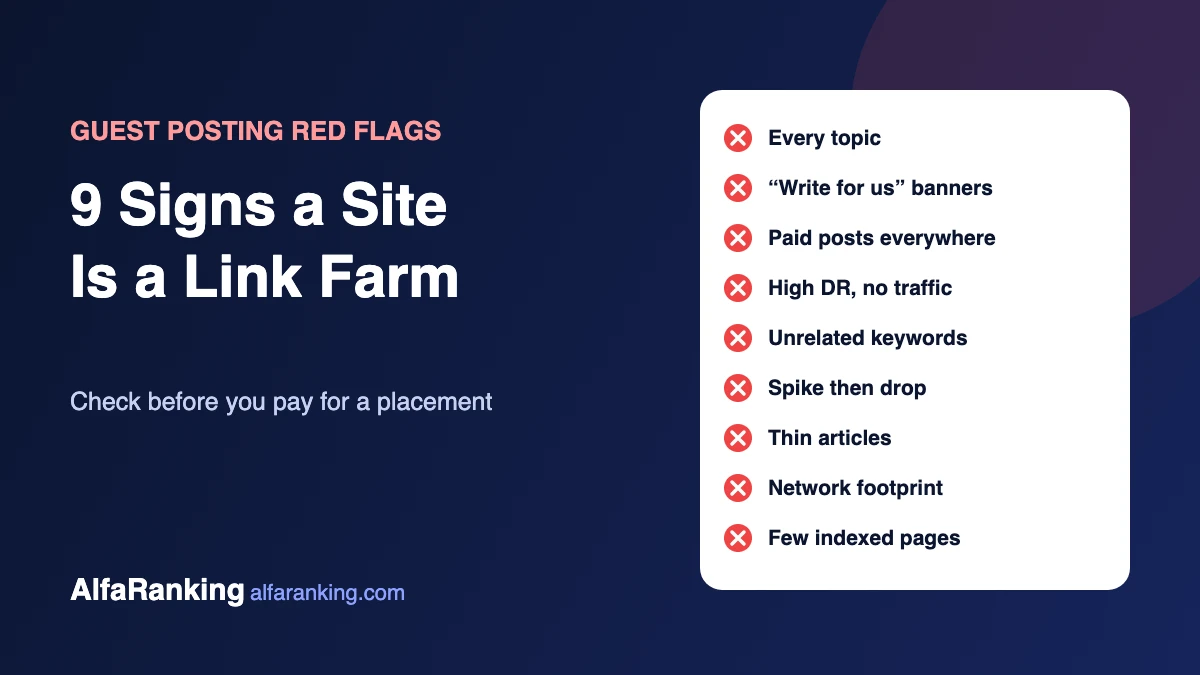
Google’s spam policies describe link schemes, including buying links that pass ranking credit and creating many links on low-quality sites, as link spam. Link farms are where many of those links come from. Here are nine signs to spot one before you pay.
1. It covers every topic under the sun
Open the category menu. If you see health, crypto, home décor, law, travel, pets, CBD and SaaS on the same site, with no clear editorial focus, the site was built to accept any paid article. A real publication has a subject and an audience.
2. “Write for us” is everywhere
Banners in the header, sidebar and footer offering “guest posts”, “DA 50+” or “permanent dofollow links” are a giveaway. Real publishers may accept contributors, but link selling isn’t their main message.
3. Most recent posts point to other businesses
Open the last 20 articles. If nearly every one links out to a company selling something unrelated to the next article, you are looking at a placement catalogue. Healthy sites publish mostly their own content.
4. High authority, almost no traffic
A DR or DA of 60+ paired with a few hundred or a few thousand organic visits a month is one of the most common red flags. Authority scores are easy to inflate with links from other sites in the same network. Traffic from Google is much harder to fake.
5. Traffic for keywords that have nothing to do with the site
Check which keywords the site ranks for in Ahrefs, Semrush or a similar tool. A tech blog that gets its visits from casino terms, essay services or celebrity net worth searches is either hacked, repurposed or selling to anyone.
6. A traffic spike followed by a cliff
Look at at least 12 months of organic traffic. A sudden rise and a sharp drop often means the site was hit by a Google update, or that the traffic was never real. Sellers usually quote the peak, so check the trend yourself.
7. Thin, spun or obviously generated articles
Read two or three posts properly. Generic intros, no real examples, no author expertise and awkward phrasing all suggest content produced only to carry links. Your article would sit among them.
8. The same template, authors and email across many sites
Search the contact email, the “about” text or an author name in Google. If they appear on dozens of near-identical sites, you have found a network. Buying several links from one network looks exactly like the link schemes Google’s policies describe.
9. Few pages in Google’s index
Search site:domain.com. If a site claims thousands of articles but Google shows only a handful, Google may have stopped trusting it. A link on a page Google never indexes is worth very little.
Red flags at a glance
| Sign | How to check | Time |
|---|---|---|
| Every topic covered | Category menu, last 20 posts | 2 min |
| “Write for us” banners | Header, sidebar, footer | 1 min |
| High DR, low traffic | SEO tool overview | 2 min |
| Unrelated keywords | SEO tool, organic keywords | 3 min |
| Spike then drop | 12-month traffic graph | 1 min |
| Network footprint | Google the contact email | 2 min |
| Few indexed pages | site: search | 1 min |
Link farm or just a broad magazine?
Not every site that covers several topics is a link farm. Big news and lifestyle magazines cover many subjects too. The difference is in the details: a real magazine has named editors, original reporting, comments or social engagement, and traffic that comes from searches matching its articles. A link farm has none of that, just a steady stream of articles that each exist to carry one outbound link.
One sign on its own isn’t proof. Three or more together usually are. When in doubt, ask the seller for the site’s traffic graph and an example of a recent sponsored post, then judge the page your article would sit beside.
What to do if you already bought links on one
Don’t panic. A single placement rarely causes a problem on its own. Stop ordering from that site, ask the publisher to remove the link or mark it rel="sponsored", and focus new placements on relevant sites with real readers. If Search Console ever shows a manual action for unnatural links, follow Google’s instructions in that report.
Want sites that pass these checks?
Before we recommend a site to a client, we check it against these signs and our 12-point checklist. Browse sample sites by niche or tell us your niche and get a free list with prices.